← Back to Students
Leah P.
Bio
Software with strong analytical thinking, excellent communication, and proven collaboration in team environments. Experienced in backend development and AI model integration. Hands-on with scalable architectures, WebSockets, Docker-based environments, and modern web technologies. Completed advanced coursework in machine learning, deep learning, and system design. Python · C# · React · ASP.NET Core · SQL · WebSockets · Docker · OpenCV · PyTorch · GitHub
Skills
Python
.NET
React
TypeScript
Docker
gRPC
FastAPI
WebSockets
ONNX
TensorFlow
PyTorch
OpenCV
Captum
Quantus
TorchScript
YOLO (Ultralytics)
GitHub
PyQt6
SQLite
Bootcamp Project
Framework and application for evaluating explainability methods in CV
Mentored by: Applied Materials
Mentors:
Hadassah HeberOdeliah Movadat
Data Science Bootcamp 2025 (Data)
Responsibilities:
Designed a stable 0–1 scoring function that can wrap any regression model, so faithfulness metrics produce accurate and comparable scores across different models.
Implemented a consistent input-processing layer supporting PyTorch, TensorFlow, YOLO, and ONNX models, ensuring repeatable and framework-agnostic explainability results.
Designed a wrapper that converts multi-channel mask outputs into a single differentiable scalar, allowing segmentation models to be explained using gradient-based methods.
Exposed and wired key explainer and metric parameters so users can highlight and tune the most influential settings directly from the application UI.
Developed a custom pixel-removal pipeline for 2-channel SEM images, iterating through multiple experiments and refinements until achieving a stable faithfulness evaluation
Led the research and integration of Quantus faithfulness metrics into the application, enabling reliable quantitative evaluation of explanation quality across a wide range of computer vision models (both Applied and external).
After exploring alternative designs, implemented a loading mode that preserves gradient flow and exposes selected internal layers, enabling gradient-based explainability without changing model code.
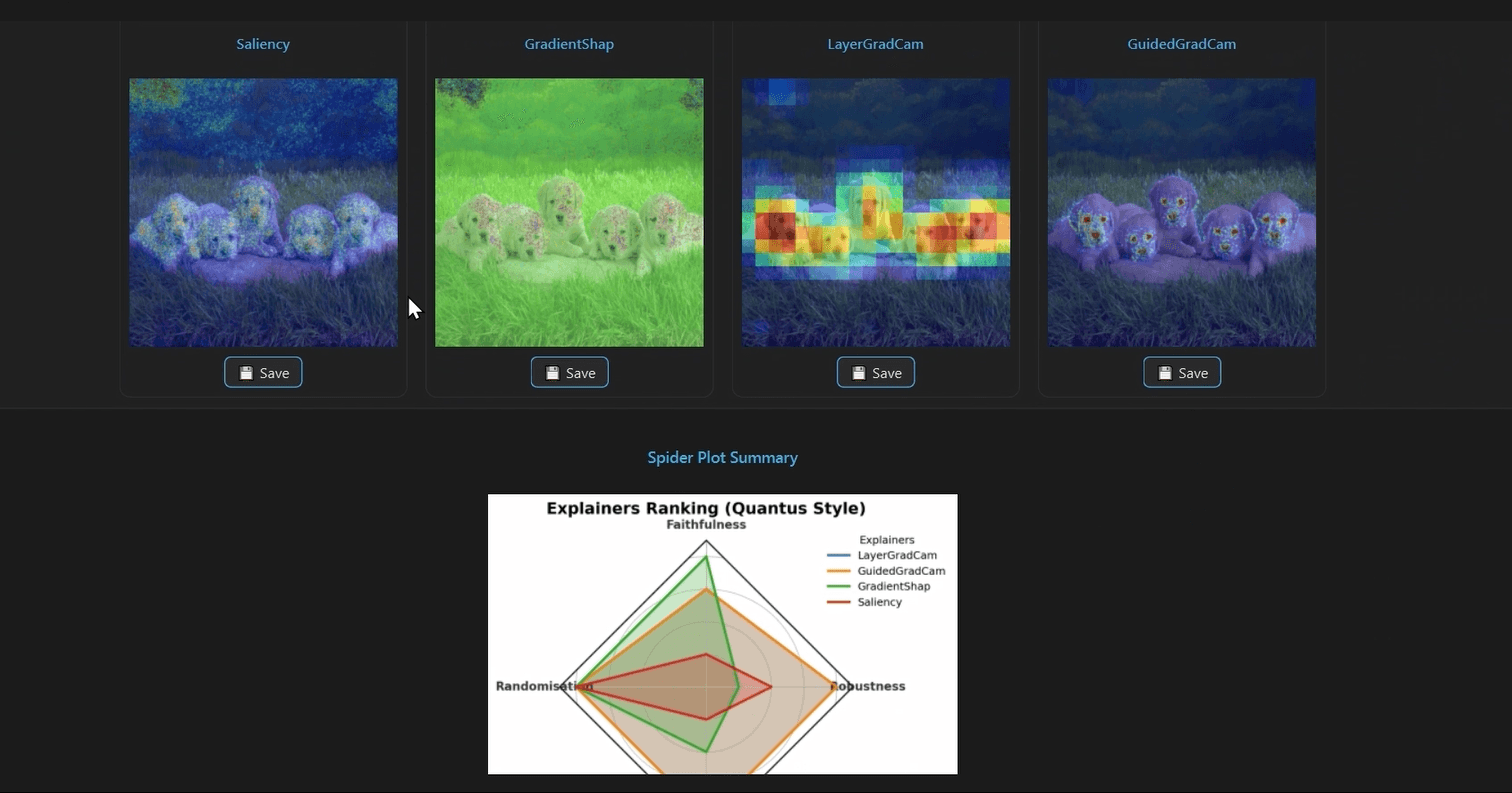
Built GUI components and a heatmaps library that display original images, overlays, and metric tables, and allow users to save and revisit multiple explanation runs per model.
Designed and implemented a dynamic form system that fetches explainer and metric metadata from the server and sends back validated, structured configurations, keeping the frontend and backend loosely coupled.
Designed and ran experiments comparing several explainability methods on Applied’s regression and segmentation models, analyzing their behavior and summarizing insights for the team.
Click to enlarge
Additional Projects
Appointment Management System for a Clinic (C#, ASP.NET Core, SQL, React)
• Implemented a scalable multi-layer backend with automated 180-day scheduling, availability rules, and structured error handling.
• Built a modular React + TypeScript interface with role-based dashboards and centralized state management (Redux Toolkit).
• Designed an extensible API layer enabling real-time synchronization with SQL Server.
English Level
Fluent