← Back to Students
Yehudit E.
Bio
Software Developer with hands-on experience building end-to-end web systems and AI-driven applications. Passionate about clean architecture, problem-solving, and understanding the internal logic behind complex systems. A fast learner, highly motivated, and detail-oriented - I enjoy taking on challenges and delivering reliable, high-quality solutions.
Skills
Python
.NET
React
TypeScript
Docker
FastAPI
CUDA
TensorFlow
PyTorch
PyQt5
Deep Learning
Textual inversion
Stable Diffusion
OpenCV
NumPy
Pandas
Matplotlib
scikit-image
GAN models
LLMs
AWS S3
Web API
Clean Architecture
Entity Framework
Angular
HTML
CSS
REST API
MySQL
Whisper
Prompt Engineering
Flask
Bootcamp Project
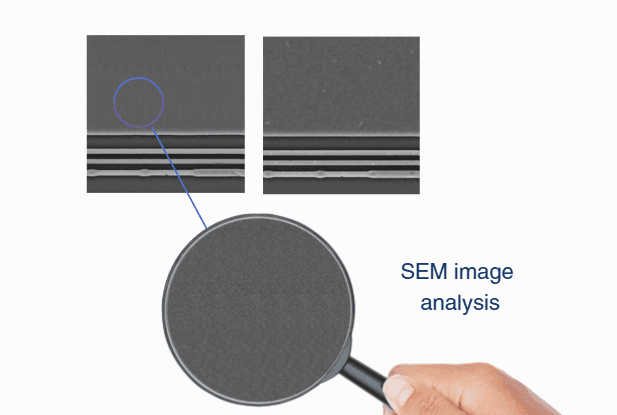
Framework for generating realistic SEM images from segmentation masks, sketches, or text
Mentored by: Applied Materials
Mentors:
Data Science Bootcamp 2025 (Data)
Responsibilities:
Research - on Textual Inversion: Explored Textual Inversion techniques, including embedding creation and integration into SDXL, to evaluate potential improvements in generation quality.
Research - Feature Extraction for Dataset Labeling: Used OpenCV to extract morphological and structural features from SEM images for dataset labeling and analysis, including attempts to extract descriptive text from features.
Dataset Creation using Meta’s SAM-2: Used Meta’s SAM-2 segmentation model to create accurate structural masks for real SEM images and build a paired dataset (mask → image) needed for training and evaluating generative models.
Pix2Pix Training (Segmentation → Image): Prepared datasets, configured experiments, and trained a Pix2Pix model to generate SEM images from segmentation maps, including epoch tracking, result analysis, and parameter tuning.
Model Evaluation Metrics Development: Designed evaluation metrics and analysis tools to compare real and generated images, assessing structural accuracy, texture fidelity, and overall realism.
Investigating Differences Between Real and Generated Images: Analyzed noise patterns, frequency characteristics, and imaging artifacts to understand the root causes of discrepancies between generated and real SEM images.
Research - Noise Modeling & Enhancement: Added a learnable noise layer to the model, designed to capture SEM-specific noise patterns during training and re-inject them during generation, in order to test whether data-driven noise could improve realism and enhance model performance.
Documentation & Results Presentation: Produced research summaries, visual comparisons, and presented findings and insights to mentors and the project team.
Click to enlarge
Additional Projects
MusiX - A SaaS platform for managing songs and playlists, built end-to-end to solve real challenges in organizing, sharing, and processing music content.
- The system includes a user-facing React client and an Angular-based admin dashboard for moderation and control.
- I designed and developed the backend in ASP.NET Core 9 with a clean, modular architecture (N-Tier, Repository Pattern, Dependency Injection), providing a scalable REST API with JWT authentication, Google OAuth2 login, and RBAC authorization.
- The platform supports public and private playlists, secure uploads, and file storage using AWS S3 with IAM roles and protected share links.
- I integrated an AI service in Python using Whisper + GPT to automatically transcribe songs.
- The data layer is built on MySQL using EF Core (Code-First).
- The system is deployed with Docker, automated CI/CD pipelines, and an Agile development process from planning through production.
RAG-Based Chat System – A Python-based backend service for retrieving and generating context-aware answers from unstructured data.
- Designed and implemented a Python server using Retrieval-Augmented Generation (RAG) architecture.
- Generated embeddings from unstructured data and stored them in a vector database (Pinecone).
- Implemented contextual retrieval to inject relevant information at inference time.
- Integrated OpenAI to generate accurate and fluent natural-language responses grounded in retrieved context.
English Level
Working Proficiency